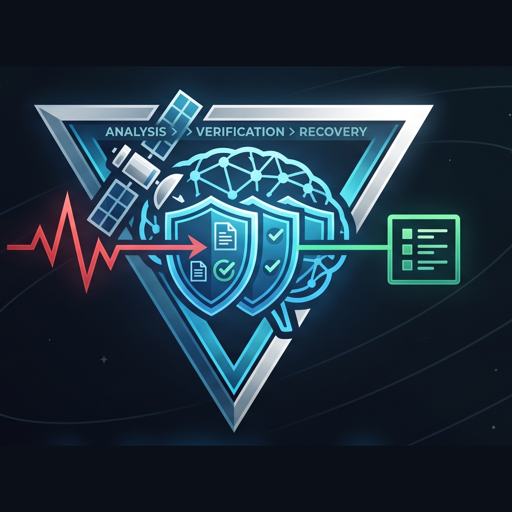
Security overview
VELA is built for the most conservative operators — sovereign programmes and defence-adjacent missions. Security is architectural, not a bolt-on. This page is the model; the zero-trust posture, the advisory boundary, and the RBAC policy go deeper.
The load-bearing property: no commanding
Section titled “The load-bearing property: no commanding”VELA reads telemetry and produces advisories. It constructs, formats, and transmits no telecommands. This is not a promise — it is enforced:
scripts/guardrails/no-commanding.shgrepsapps/andvela/for command issuance identifiers (issueCommand,sendCommand,send_command,sendTelecommand,transmit_command,dispatchCommand,uploadCommand,/api/**/commands, …).- It runs as a pre-commit hook and in two CI workflows.
- Reading command history (
get_command_history) and the telecommand context filter are deliberately allowed and are core features — they are how VELA distinguishes a real fault from an expected command response.
Grounding integrity
Section titled “Grounding integrity”Every narrative/procedure claim carries Citation objects that resolve via vela.audit.citation_check.
The rule is symmetric and both halves are enforced:
- a grounded step with no citations is a violation → emit
UNGROUNDEDinstead; - an
UNGROUNDEDstep that carries citations is also a violation → it must carry none.
check_citations returns ok (integrity holds) and releasable (ok and no ungrounded steps).
A hallucinated reference is a sev-1 — see the
citation-integrity incident-response runbook.
Threat model & zero-trust posture
Section titled “Threat model & zero-trust posture”The zero-trust posture covers the trust boundaries in full. In summary:
- Data-in never becomes action-out. The only mutating operation is releasing a drafted advisory to operators; there is no path from ingested data to a spacecraft command.
- Agents are sandboxed to the MCP boundary (import-linter enforced) — reasoning cannot reach a store or adapter directly.
- Determinism where possible — graph traversal, event forming, and citation checking are
deterministic and unit-tested; replay is seeded and
as_ofis fixed.
Identity & access control
Section titled “Identity & access control”- RBAC —
viewer/operator/approver. The release of any advisory is gated behind an explicit, role-checked approval. The server (a403) is the real enforcement point; the UI only gates affordances. - Enterprise SSO — SAML and OIDC, behind a
build_authenticatorseam. - Provisioning — SCIM 2.0 (Okta / Entra / Keycloak), tenant-partitioned.
- Secrets — API keys and DB passwords are read from the environment at connect time, never from config files.
Tenant isolation
Section titled “Tenant isolation”Every KG read goes through a store scoped to the caller’s tenant, and the whole investigation (event → report → record → audit) is tagged with the caller’s tenant. Per-tenant encryption keys and customer-managed keys are on the roadmap roadmap.
Auditability
Section titled “Auditability”Every investigation, approval, and release is recorded in an immutable audit trail, and advisories can
be exported to a SIEM (CEF/OCSF/JSON) on release. graph.get_state_history() yields the forensic
replay sequence — “one investigation, one record”. Audit-log retention is governed by the
retention policy.
Air-gap & data residency
Section titled “Air-gap & data residency”VELA runs fully air-gapped: the offline default uses in-memory stores + seeded replay, self-hosts
its fonts, and performs no external network egress. The live telemetry sources are structurally barred
in airgap mode. For sovereign and defence customers this is the default posture — telemetry never
leaves your infrastructure. See Deployment.
Export control
Section titled “Export control”Spacecraft-related software and technical data may fall under India’s SCOMET controls (DGFT, Foreign Trade Policy) and related regimes. Air-gapped, in-country deployment is offered specifically so sensitive operational data need not cross a border. Regulatory specifics for a given deployment should be confirmed with counsel.
Regulatory alignment
Section titled “Regulatory alignment”VELA is designed to India’s DPDP Act 2023 (data-principal rights + a grievance mechanism; the Act phases in through May 2027, with the IT Act / SPDI Rules governing in the interim). As a body corporate it is subject to the CERT-In Directions of 28 April 2022 (IT Act s.70B(6)): reporting a covered cyber incident within 6 hours, and retaining ICT logs for a rolling 180 days within Indian jurisdiction — which an air-gapped deployment satisfies by construction.
Certifications are pursued in customer-driven order and never claimed before held roadmap: ISO/IEC 27001, SOC 2 Type II, and a VAPT by a CERT-In-empanelled auditor (empanelment is a credential for auditing firms, not a product — a vendor engages an empanelled auditor rather than “being empanelled”). These are the usual credentialing path into iDEX / Ministry of Defence procurement.
IN-SPACe. A read-only, non-commanding advisory ground-software vendor is not itself among IN-SPACe’s enumerated authorizable activities — that authorization sits with the operator customer. VELA processes telemetry, not remote-sensing imagery, so the high-resolution EO-dissemination trigger (GSD ≤ 30 cm) does not apply to it.