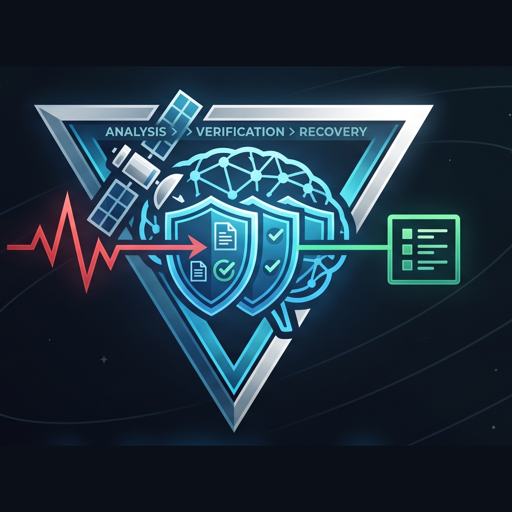

Project VELA
The autonomous AI for satellite anomaly investigation. A telemetry deviation becomes a cited root-cause narrative and a drafted recovery procedure — reasoning across the spacecraft's own manuals and knowledge graph, every claim traceable, and air-gap deployable.
A Verified Evidence Layer for Anomalies: every claim is verifiable, or it is blocked.
How it works
Section titled “How it works”
A telemetry deviation is flagged — onboard, or by ground detection.
VELA investigates and builds a cited root-cause narrative.

A cited recovery procedure, validated and ready for your team to run.
Why VELA
Section titled “Why VELA”
Cited or blocked
Every narrative and procedure claim resolves to the spacecraft's own manuals and knowledge graph — or it is emitted as
UNGROUNDED and held from release.
End-to-end agentic investigation
From the first deviation to a drafted recovery, VELA runs the whole investigation itself — triage, hypothesis, validation, and drafting — as a deterministic agent graph that reaches data only through an audited boundary.
Air-gap & sovereign deployable
Runs fully offline with in-memory stores and keyword search, or against your own Neo4j and Qdrant — no external calls, no CDN, no data leaving the ground segment.
Standards-universal ingest
Telemetry enters through one swappable source: CCSDS / PUS, XTCE, Yamcs, OpenC3, MQTT, or seeded replay — the reasoning above it never changes.
Deterministic & reproducible
Graph traversal, event forming, and citation checks are deterministic and unit-tested; replay is seeded, so an investigation reproduces exactly.
Predictive, not just reactive
Beyond live faults, VELA projects remaining-useful-life from each component's degradation trend — surfacing the failure that is coming, not only the one that already happened.
Start here
Section titled “Start here”New to VELA? Start here for the one-paragraph architecture, the non-negotiable guardrails, and a map of the documentation — or jump straight to setup & commands to run your first investigation.
Built by SKOPAQ AI Pvt Ltd. Proprietary. This documentation describes the system as built; where something is planned rather than shipped, it is marked roadmap.